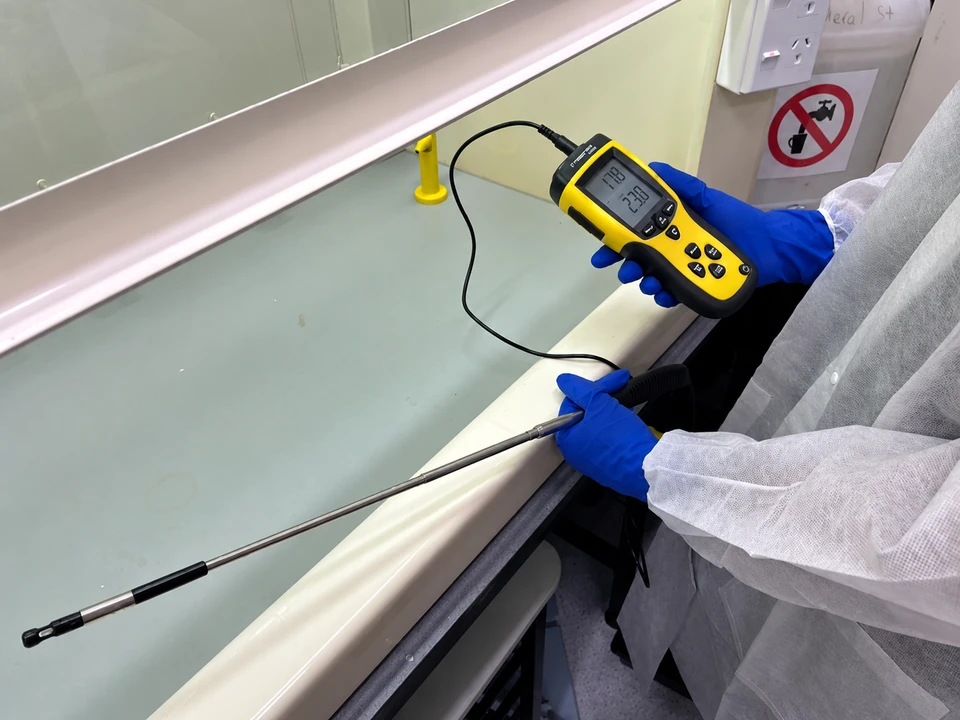
The test measures how fast air is pulled into the front of the cupboard (the face velocity). It uses smoke to check that fumes stay inside. It checks that the airflow alarm works. It also looks at the ducts, the fan and the outlet where fumes leave the building (the discharge).
Once the schedule's checks have been done for the past 12 months, the IQP gives you a certificate called a Form 12A. The building owner needs it for the yearly building warrant of fitness (BWoF).
FumeCare is based in Henderson, Auckland. It is IQP registered to test and certify SS11 fume cupboards, and it makes the Calibre range of fume cupboards. To book, call 0800 023 778 or email info@fumecare.co.nz. Tell us your address, how many cupboards you have and your BWoF anniversary date (the date your warrant is due each year).
This page is for the people who organise fume cupboard testing: laboratory managers, school science heads and technicians, and facilities or property managers whose building has SS11 fume cupboards with a test or BWoF anniversary coming up. It will also help if a cupboard has failed, been moved or repaired, or your Form 12A is overdue.
Fume cupboard testing at a glance
| Question | Answer |
|---|---|
| Who needs it | Any building whose compliance schedule lists SS11 lab fume cupboards. This includes school science rooms, university and hospital labs, council and water labs, and testing and research labs. |
| Legal basis | The Building Act 2004 and the Building (Specified Systems, Change the Use, and Earthquake-prone Buildings) Regulations 2005. These regulations list lab fume cupboards as SS11. |
| Standard | Usually AS/NZS 2243.8:2014 Safety in laboratories, Part 8: Fume cupboards. Your compliance schedule names the standard to use. |
| How often | At least once a year for the Form 12A. More often if your compliance schedule says so. |
| Who can test | An IQP registered with the council for SS11. You can check your council's list of IQPs (its IQP register). |
| What you get | A test report for each cupboard. Once all the schedule's checks are done, you also get a Form 12A for the BWoF. |
Fume cupboard certification in NZ
In New Zealand, fume cupboard certification means the Form 12A. An IQP registered for SS11 issues it once the inspection, maintenance and reporting procedures in your building's compliance schedule have been met for the previous 12 months. It is not a one-off: each cupboard on the schedule needs testing, and a new Form 12A is needed every year to support the building owner's BWoF. A cupboard that fails is repaired and retested before it can be certified.
Fume cupboard testing in NZ: which standard applies
Testing for the Form 12A is done against the standard your compliance schedule names. For SS11 that is usually AS/NZS 2243.8, the joint Australian and New Zealand fume cupboard standard (see our AS/NZS 2243.8 fume cupboard standards guide). You may see the European EN 14175 or the American ASHRAE 110 test methods in specifications or manufacturers' data, but they do not replace the schedule's standard for the BWoF. The tester must be an IQP registered with your council for SS11, so check your council's IQP register. FumeCare is based in Henderson, Auckland and is IQP registered for SS11 fume cupboards.
What an SS11 fume cupboard test covers
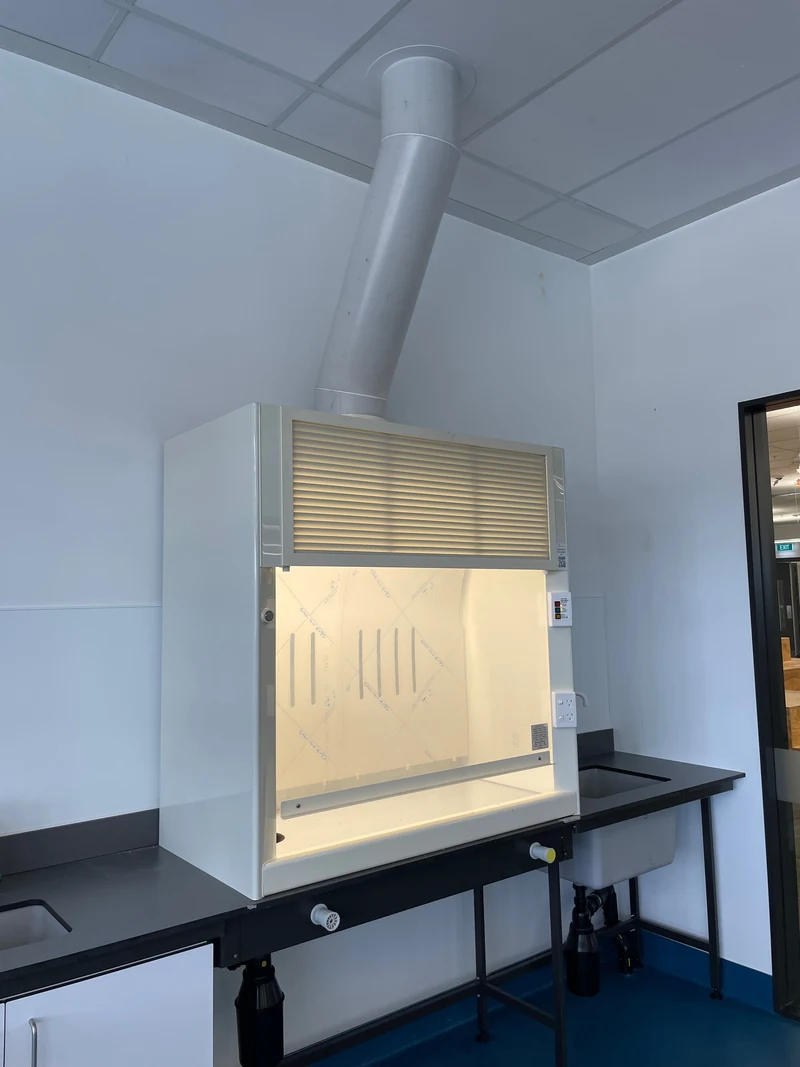
Your compliance schedule sets the exact checks for your building. A typical test of a ducted fume cupboard (one that sends fumes outside through a duct) covers these checks.
| Check | What the tester does | What a pass looks like |
|---|---|---|
| Face velocity (how fast air flows in) | Measures the air speed with an anemometer (an air speed meter) at a grid of points across the front opening, with the sash (the sliding glass front) at its working height. On Calibre cupboards that is the sash stop. | The average meets the figure for that cupboard, with no weak spots where fumes could escape. FumeCare's Calibre instructions call for an average above 0.5 metres per second (m/s). |
| Smoke test (containment) | Releases smoke you can see around the edges of the sash, along the work surface and inside the cupboard. | The smoke is pulled in and carried away. None escapes into the room, and no air flows back out of the opening. |
| Airflow display and alarm | Checks the airflow display, then lowers the airflow on purpose to test the alarm. | The display shows normal when the cupboard is running, and the alarm sounds when the airflow drops. |
| Sash and bypass | Slides the sash all the way up and down. Checks the counterbalance (the part that holds the sash in place), the glass and any bypass grille (a vent that lets air in as the sash is lowered). | The sash moves smoothly and stays where you leave it. The glass is not damaged and the bypass is clear. |
| Cupboard condition | Looks at the baffles (the panels at the back that guide air out), the inside lining, the work surface and the services such as taps and power points. | The gaps in the baffles are clear. There is no damage or corrosion (damage from chemicals) that affects airflow or safety. |
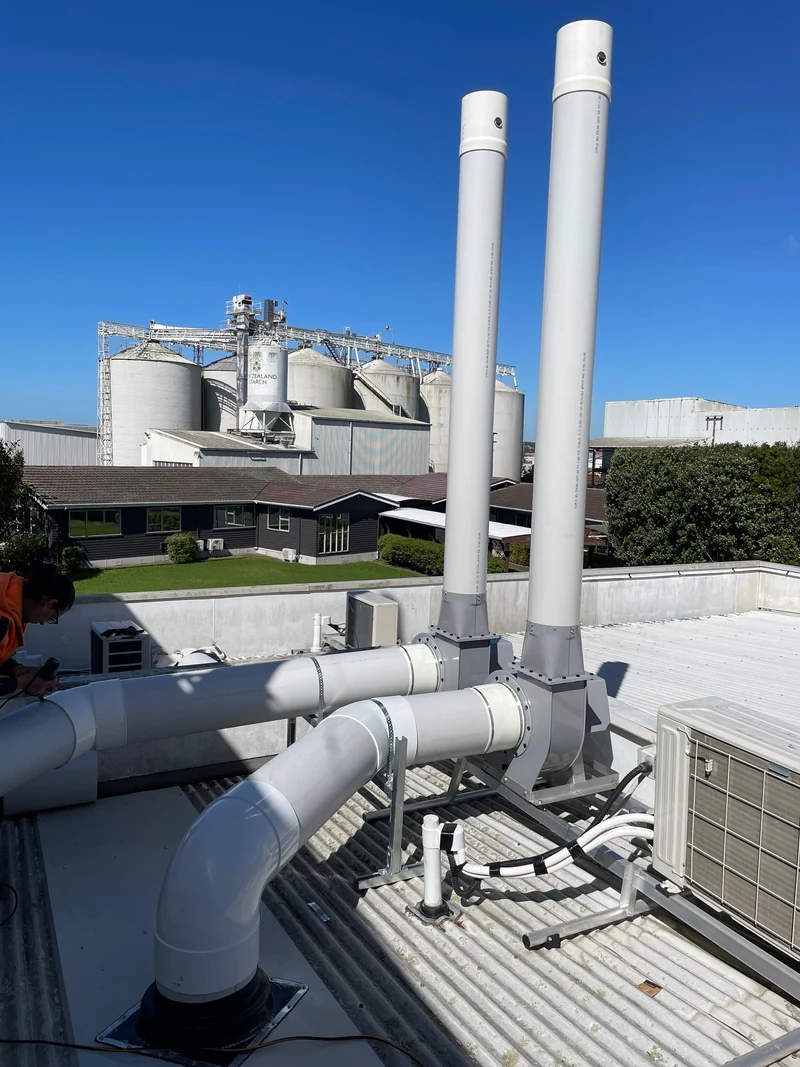
| Fan, duct and discharge | Checks the exhaust fan, the duct joints and supports, and the discharge stack on the roof (the pipe where fumes leave the building). | The fan runs properly, the duct is in good condition and not leaking, and nothing blocks the discharge. |
The tester also notes anything in the room that disturbs the airflow at the front of the cupboard. This could be a door, a vent blowing air into the room or a walkway close by. Our guide to fume cupboard face velocity explains what the reading means and why it drops.
How often fume cupboards need testing
Your compliance schedule sets the legal timing. The Form 12A covers the past 12 months, so every SS11 cupboard needs testing at least once a year. Some schedules add more frequent checks, and FumeCare's Calibre user handbooks list smoke and velocity tests every six months as routine maintenance. It is also good practice to have a cupboard checked before it goes into use, or back into use:
Annual servicing and IQP testing and certification of fume cupboards is mandatory under AS/NZS 2243.8:2014. Plan for both every year, and book them together with us.
- after it is installed or first set up (commissioned); see our laboratory commissioning guide for that handover
- after it has been moved
- after repairs or changes to the fan, ducts, controls or alarm
- after changes to the room's airflow, such as new vents blowing air in or a new door
- when the work done in it changes a lot, or users notice smells, repeated alarms or fumes they can see
From booking to Form 12A
- Find your compliance schedule and its anniversary date. Ask the building owner or facilities manager for the latest copy. Look at the SS11 entry. It names the standard and explains how the cupboards must be inspected, maintained and reported on.
- Book an IQP registered for SS11. Tell them how many cupboards you have, which rooms they are in, and whether the fans are on a roof or in an area with limited access.
- Get the rooms ready. Plan the visit around classes or experiments. Finish any work in each cupboard, clear the front of the work surface and leave the room's ventilation running as usual.
- Testing on site. Each cupboard is tested while it runs as normal. The fans, ducts and discharge are checked too.
- Report. You get the results for each cupboard, with any faults and what to do about them.
- Form 12A. Once the schedule's checks have been done over the past 12 months, the IQP gives you the Form 12A.
- BWoF. On the schedule's anniversary date, the building owner signs the building warrant of fitness (Form 12). They send it to the council with the IQP certificates and put it up in a public place in the building.
If a cupboard fails
Put a label on a failed cupboard saying it is out of use until it is fixed. The IQP can't sign the Form 12A until the schedule's checks are met, so the cupboard must be repaired and retested first. Common reasons for a fail are:
- a fan problem, such as a worn belt, a failing motor or a fan spinning the wrong way
- a blocked, damaged or leaking duct, or a blocked outlet (discharge)
- a damaged sash, a sash that won't stay in place, or a damaged bypass grille
- bottles or equipment blocking the gaps in the baffles
- draughts across the front from doors, vents or people walking past, or not enough fresh air coming into the room to replace what the cupboard removes (see our fume hood make-up air guide)
- an airflow sensor or alarm that is faulty or giving wrong readings
FumeCare services and repairs fume cupboards, fans and ducts. It also makes Calibre fume cupboards (Student, Smoothflow and SashDrive), Fumeflow D250 and TD250 exhaust fans and PVC ducting. This means one team can do the repair and the retest for the Form 12A.
Ducted fume cupboards and recirculating cabinets
AS/NZS 2243.8 covers ducted fume cupboards, which send fumes outside. Recirculating (ductless) fume cabinets work differently. They filter the air and send it back into the room. They are outside AS/NZS 2243.8 and covered by a different standard, AS/NZS 2243.9. Whether one appears on a compliance schedule depends on the building, so check yours. If your schedule does list one, follow the schedule. Because a ductless cabinet relies on its filters, have its airflow and filters checked as the maker advises. If you are still choosing between the two types, see our ducted or ductless fume hood guide.
What to have ready
| Gather | Why it helps |
|---|---|
| Current compliance schedule and anniversary date | Shows which checks apply and when the report is due. |
| List of cupboards: room, asset number, make and model | Matches each cupboard to the schedule and the records. |
| Past test reports and Form 12As | Shows any recommendations that haven't been done yet. |
| Maintenance and repair records | Shows what work was done, when and by whom. |
| Changes, faults and new uses | Points out cupboards that may need a closer look. |
Missing something? That's fine. Call 0800 023 778 or email us and we'll take it from there.
What affects the cost of fume cupboard testing
The price mainly depends on how many cupboards are tested in one visit, where your site is, how easy it is to reach the fans and discharge stacks (the outlets where fumes leave the building), and whether anything needs fixing before the Form 12A can be issued. FumeCare takes 15% off when you book annual certification and maintenance together. Ask for a quote and tell us how many cupboards you have and where they are.
Every job is quoted for its site. We test fume cupboards from Auckland to Northland.
Why FumeCare
- IQP registered to test and certify SS11 fume cupboards.
- Maker of the Calibre range. Calibre cupboards have been put into labs and schools across New Zealand and the Pacific Islands for over 30 years.
- Over 20 years of experience working with thermoplastics (plastics such as PVC that can be heated and shaped), and making fume cupboards, exhaust fans and ducts.
- One team to supply, install, service, repair and certify.
- Clients include Watercare laboratories, LabPlus Auckland DHB, the Ministry for Primary Industries, NZ Plant and Food Research, Eurofins and NZ Racing Labs.
- Testing, servicing and installation from Auckland to Northland.
Fume cupboard testing FAQs
Is a Form 12A the same as a building warrant of fitness?
No. The Form 12A is the IQP's certificate. It says the inspection, maintenance and reporting steps for a specified system, such as SS11, have all been followed over the past 12 months. The BWoF (Form 12) is the building owner's yearly statement to the council. It says every specified system on the compliance schedule has met its steps. The Form 12As back it up.
How long is a Form 12A valid?
It covers the 12 months before the date it is issued. You need a new one every year for the BWoF, so book testing well before your anniversary date.
What face velocity should a fume cupboard have?
The IQP checks the readings against AS/NZS 2243.8 and the cupboard's design. For reference, FumeCare's Calibre instructions call for an average above 0.5 m/s with the sash raised to its stop, and the Student and Smoothflow handbooks recommend commissioning to 0.55 m/s. Our face velocity guide explains how it is measured and the usual reasons for low readings.
Do ductless fume cabinets need SS11 testing?
It depends on your compliance schedule. Recirculating (ductless) cabinets are outside AS/NZS 2243.8 and are covered by AS/NZS 2243.9 instead. If your compliance schedule lists one, it must be inspected the way the schedule says. Either way, have its airflow and filters checked as the maker advises.
Can our own staff test the fume cupboards?
Staff should do everyday user checks, such as watching the airflow display, keeping the baffle gaps clear and reporting alarms. Some compliance schedules also include checks by the owner. But the IQP inspections and the Form 12A must come from an IQP registered for SS11.
Our Form 12A is overdue. What should we do?
Book a test straight away and tell the IQP your anniversary date. If the BWoF will be late, contact your council. The building owner is responsible for getting it in on time.
Is a fume hood the same as a fume cupboard?
Yes. Fume cupboard is the usual name in New Zealand, Australia and the UK. Fume hood is the American name. Both mean an enclosed, ventilated workspace that pulls air in through the front opening and carries fumes away from the person using it.
Book your fume cupboard test
Call 0800 023 778 (Monday to Friday, 8am to 5pm) or email info@fumecare.co.nz. Tell us your address, how many cupboards you have and your BWoF anniversary date. Book annual certification and maintenance together to save 15%.
About this guide
Written by FumeCare Ltd, a New Zealand owned and run company based in Henderson, Auckland. FumeCare is IQP registered for compliance testing and certification of SS11 fume cupboards, and issues the Form 12A that supports the building warrant of fitness.
We test, service and install fume cupboards from Auckland to Northland.
FumeCare took over the licence and manufacturing of the full Calibre fume cupboard range (Student, Smoothflow and SashDrive). Calibre cupboards have been installed in labs and schools across New Zealand and the Pacific Islands for over 30 years. FumeCare also makes the Fumeflow D250 and TD250 exhaust fans and fabricates PVC ducting, and it services and repairs cupboards, fans and ducting. That covers every part an SS11 test looks at, from the sash to the discharge stack.
The team has over 20 years of experience in thermoplastic fabrication and in making fume cupboards, exhaust fans and ducts. FumeCare is led by Managing Director Carlos Tikaram, with Alex Tikaram as foreman and site coordinator.
Last reviewed: November 2026.
Main sources: the Building Act 2004; the Building (Specified Systems, Change the Use, and Earthquake-prone Buildings) Regulations 2005, Schedule 1; the Building (Forms) Regulations 2004 (Form 12 and Form 12A); AS/NZS 2243.8:2014 Safety in laboratories, Part 8: Fume cupboards; AS/NZS 2243.9 Safety in laboratories, Part 9: Recirculating fume cabinets; MBIE guidance on compliance schedules and building warrants of fitness; and FumeCare's Calibre installation instructions and user handbooks (face velocity figures, sash stop and maintenance schedule).
Found a mistake or something out of date? Email info@fumecare.co.nz and we will check it and fix the page.