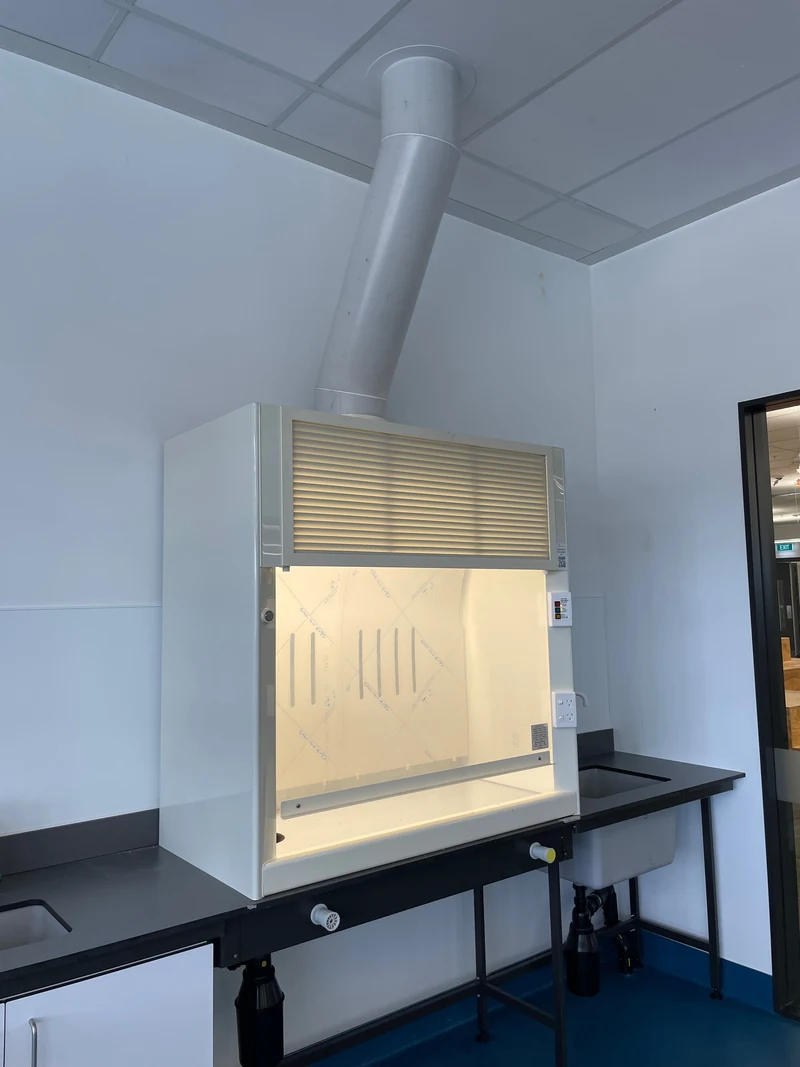
Separate the three design choices
| Choice | What it describes | Your starting question |
|---|---|---|
| Ducted or filtered | The route taken by the extracted air | What substances and processes must the system handle? |
| Constant or variable volume | The way exhaust airflow responds during use | How will the cupboard and building controls work together? |
| Enclosure format | The available work area and access | What equipment must fit and how will it be operated? |
These choices interact. A label such as “benchtop” describes the physical arrangement, rather than proving suitability for a particular chemical.
Where the task could use an open capture arrangement, compare an enclosed cupboard and canopy with your safety adviser. For chemical compatibility questions, the acid-work brief shows the process details to gather.
Decide what happens to the extracted air
A ducted cupboard connects to an exhaust route. A ductless enclosure uses a specified filtration arrangement and returns treated air to the room. The suitability assessment needs to cover the actual substances and workload, along with the equipment’s instructions.
Our ducted and ductless comparison sets out the procurement questions for these methods. If you are trying to identify an existing installation, the guide to filters and extraction explains which records to gather.
We manufacture Calibre cupboards and the associated Fumeflow extraction equipment. Bring the chemical list into the discussion before deciding on a configuration.
Understand the airflow-control description
Bypass designs provide another air-entry path as the sash closes. Student and Smoothflow use a bypass arrangement. SashDrive instead uses sash position to regulate exhaust fan speed. These are different ways of managing the cupboard’s airflow during use.
Use our bypass explanation to understand the grille’s role, or the variable-air-volume guide to prepare questions about controls and operating conditions. The final choice also needs to suit the room’s air supply and the extraction system.
For the model-level discussion, compare Student, Smoothflow and SashDrive.
Match the enclosure to the work
Record the largest apparatus, the operator’s access needs and any services the procedure requires. Include the space needed to load, adjust and remove equipment, rather than measuring only its footprint.
- Start with our benchtop guide for a bench-mounted installation.
- Use the dimensions guide to separate external measurements from usable working space.
- For teaching rooms, review school cupboard planning with the science and property teams.
Specialist procedures may need a different enclosure or assessment. Describe the complete task so the equipment conversation starts with the protection and access it requires.
Look beyond the outer dimensions when planning the working setup. Understand the front air-entry component and rear baffles so apparatus can be positioned around the intended air path.
Plan the cupboard’s working life
A selection decision should include how the equipment will enter service and be cared for. Agree the commissioning and handover requirements, then use a supervisor’s induction plan to introduce the actual cupboard and local procedures.
For existing equipment, a clear fault report helps organise service support. If a cupboard is being retired, prepare a decommissioning handover with the laboratory and facilities team before work starts.